
Solar Input vs Battery Capacity: Where Should You Spend Your Money?
A larger battery postpones a charging shortfall; it does not fix it. Balance daily consumption, usable storage and realistic energy replacement.
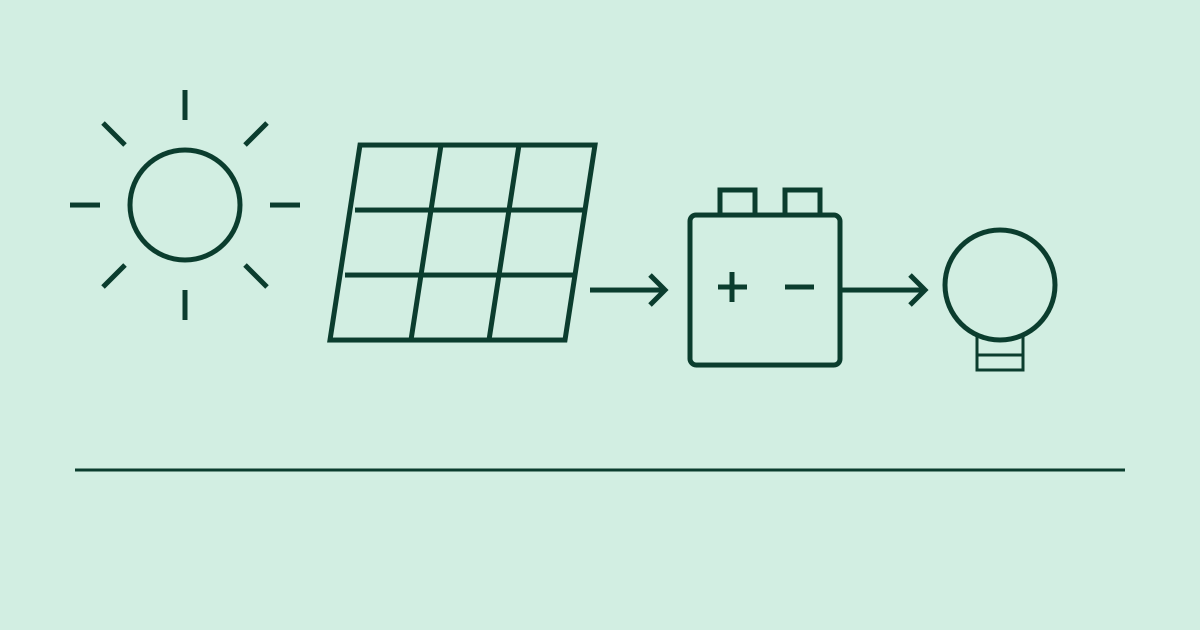
A battery determines how much energy you can carry into camp. Solar charging determines how much you can replace while you are there. Spending on only one side can leave a poorly balanced system.
A short stay starting with a full battery and a week of daily fridge use present different buying decisions. In the first case, stored energy may be your main constraint. In the second, replenishing it becomes harder to ignore.
Storage and charging are different quantities
Battery capacity in watt-hours (Wh) describes stored energy. Solar input in watts (W) describes a rate of energy transfer. The power station's maximum input is an acceptance limit, not a promise of panel output.
Watts multiplied by hours gives watt-hours. Actual charging varies with sunlight, orientation, shading, heat, controller behaviour and battery state of charge.
Start with the daily load
List the loads, their operating time and whether they cycle. A fridge's start-up wattage multiplied by a whole day is not its daily consumption; a power meter or representative manufacturer test gives a better basis.
Include phones, cameras, lighting and system overhead. Keep your energy accounting on a consistent basis and include the conversion losses of your actual system—not an assumed universal efficiency.
A simple example, not a recommended setup
Suppose 600 Wh is drawn from the battery in a day, including system losses. Suppose solar actually adds 400 Wh to the battery, after charging losses—equivalent to storing an average of 100 W for four hours. These are hypothetical energy-accounting inputs, not measurements, panel ratings or power-station specifications.
| Item | Calculation | Energy |
|---|---|---|
| Daily use | Total drawn from the battery, including overhead | 600 Wh |
| Solar replacement | 100 W actually stored × 4 equivalent hours | 400 Wh |
| Shortfall | 600 − 400 | 200 Wh per day |
A larger battery buys time; it does not remove that recurring shortfall. For a longer stay, you need more compatible charging, less consumption or another energy source. Extra storage still provides a reserve for poor conditions.
Why more panel watts can disappoint
Nameplate power comes from specified test conditions. Clouds, shade, poor orientation and panel heat can reduce harvest. Four hours outdoors is not four hours at rated output, even on a trip where you expect good weather.
The controller or power station can cap charging too. Extra panel watts cannot force it past that limit, and an incompatible array can damage equipment.
When storage deserves the budget
Prioritise enough usable storage for night-time loads and a reserve. It can be the more useful upgrade for a short stay that begins fully charged, or where solar exposure is unreliable. Generous charging input does not solve insufficient overnight storage.
When charging deserves the budget
For several days of daily use, address a recurring energy deficit before simply buying a bigger battery. Once overnight storage and reserve are adequate, compare realistic solar harvest with the product's vehicle or mains-charging options.
Reducing an energy-intensive task can also be cheaper and easier than upgrading either side of the system.
Sources and further reading
Victron: SmartSolar MPPT technical specifications documents power, voltage and current limits, including cold-condition open-circuit limits. Victron: Battery voltage and energy data covers storage quantities. These are engineering references, not specifications for Kilele's listings.
Specifications vary by manufacturer and product. Check the maker's current documentation before you buy or travel.